
The Nuts and Bolts of Dermal Fillers: From Hyaluronic Acid to Supply Chain
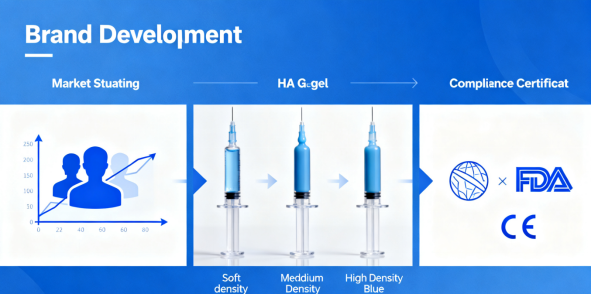
So, what exactly is a dermal filler? At its core, it’s an injectable gel, primarily composed of substances like hyaluronic acid (HA), calcium hydroxylapatite, or poly-L-lactic acid, designed to restore volume, smooth lines, and contour the face. For you as a B2B distributor or importer, understanding the raw material science is your first step. Over 80% of the global market is dominated by HA-based fillers due to their biocompatibility and reversibility. The production isn’t just a cosmetic whim; it’s a precise biochemical process. Manufacturers like us synthesize HA through bacterial fermentation (from Streptococcus zooepidemicus), then cross-link the molecules to increase longevity in the skin from 6 to over 18 months. The concentration, particle size, and cross-linking technology (like BDDE or DVS) define the product’s viscosity, elasticity, and clinical indication—whether it’s for fine lip lines or deep cheek augmentation. In 2024, the global dermal filler raw material market is valued at approximately $1.2 billion, with a CAGR of 7.5%, driven by advancements in bio-stimulatory fillers and longer-lasting formulations. For your procurement strategy, knowing that South Korea, China, and Europe are key hubs for high-purity HA production can streamline your sourcing.

Here’s a quick snapshot of primary filler types and their industrial characteristics:
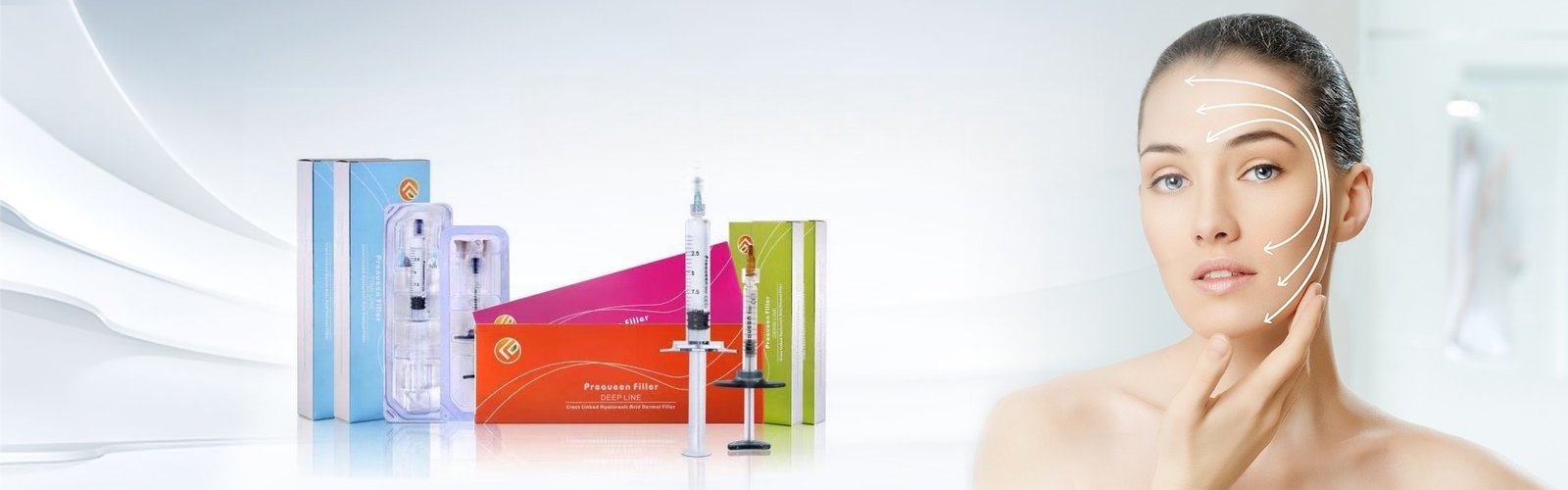
| Filler Type | Main Component | Average Duration (Months) | Key Manufacturing Regions (2024) | Primary B2B Application Focus |
|---|---|---|---|---|
| Hyaluronic Acid | Bacterial-fermented HA | 6-18 | South Korea, China, France | High-volume demand, versatile for clinics & med-spas |
| Calcium Hydroxylapatite | CaHA microspheres in gel | 12-24 | USA, EU | Specialized distributors for volumizing & facial sculpting |
| Poly-L-lactic Acid | PLLA micro-particles | Up to 24+ | Switzerland, USA | Niche, physician-driven markets for collagen stimulation |
| Polymethylmethacrylate (PMMA) | PMMA microspheres | Permanent | EU, Latin America | Limited, regulated markets requiring specialist networks |
The Global Market Pulse: Demand, Regulations, and Distributor Opportunities
Let’s talk numbers and territories. The global dermal filler market size hit $6.8 billion in 2023 and is projected to reach $9.4 billion by 2028. This isn’t just a “Western” trend anymore. While North America and Europe hold about 65% market share, the Asia-Pacific region is exploding with a forecasted CAGR of 9.2% through 2028. For you as an international trader, this means dual strategies: supplying established FDA/CE-marked products to mature markets and navigating the burgeoning regulatory landscapes in places like the Middle East (GCC) and Southeast Asia. Each country has its own medical device classification—in the U.S., fillers are Class II or III devices under the FDA; in the EU, they fall under MDR Class IIa/IIb. A distributor’s due diligence now must include verifying the manufacturer’s ISO 13485 certification, clinical data portfolios, and local regulatory approvals (like NMPA in China, KFDA in South Korea, or ANVISA in Brazil). The real-time shift we see in 2024 is the surge in combined therapies (fillers with micro-focused ultrasound or energy-based devices), creating bundled product opportunities for distributors who can supply complementary technologies.
Building a Robust Supply Chain: Logistics, Compliance, and Partnership
Your role as a connector between manufacturers and clinics is critical. The logistics aren’t simple. Dermal fillers often require controlled temperature shipping (2-25°C) to maintain sterility and product integrity. Think about the cold chain logistics from our factory in Shanghai to a clinic in Dubai or Sao Paulo. Beyond shipping, you’re the compliance gatekeeper. Are you importing into MDR-regulated Europe? You need a full Technical File, Declaration of Conformity, and Post-Market Surveillance reports from your supplier. For the U.S. market, FDA pre-market approval (PMA) or 510(k) clearance is non-negotiable. Smart distributors in 2024 aren’t just moving boxes; they’re providing value-added services: marketing kits, practitioner training modules (in partnership with manufacturers), and inventory management tech solutions. The most successful B2B partnerships we see are with distributors who engage in co-branded educational workshops for end-clinics, using real-world clinical data from the manufacturer to drive product adoption and safe usage.
Synergy Across Sectors: How Fillers Intersect with Pharma, Tech, and Aesthetics
This industry doesn’t exist in a vacuum. For a global trader, recognizing cross-industry intersections opens new channels. The pharmaceutical supply chain is a parallel universe. The sterile manufacturing processes, vial filling, and quality control (QC) labs for fillers mirror biologic drug production. Some major filler manufacturers are divisions of large pharma conglomerates. Then there’s the medical device and technology sector. The syringes, cannulas, and injection aids used are a separate B2B product line. In 2024, the integration of AI-assisted injection mapping software is rising—distributors who can offer a “total solution” (filler + planning software + injection tools) have a clear edge. Furthermore, the professional aesthetics sector—encompassing dermatology, plastic surgery, and dental clinics (for lip and perioral treatments)—requires tailored approaches. A distributor selling to a high-end dermatology chain in Germany needs a different product mix (perhaps more premium, longer-lasting fillers) and support than one supplying to a nationwide med-spa franchise in Mexico.
The Future-Proof Portfolio: Trends Shaping Your Next Order
To stay ahead, your product catalog must evolve. The buzzwords for 2024-2025 are “bio-stimulatory,” “personalized,” and “sustainable.” Next-gen fillers are moving beyond simple volumizing to actually stimulating collagen (like PLLA and newer HA formulations with added amino acids). From a sourcing perspective, inquire about manufacturers’ R&D in sustainable sourcing of raw materials and recyclable or reduced packaging—this is becoming a tender requirement in European markets. Another tangible trend is the demand for higher G-prime (cohesivity) fillers for structural contouring and lower G-prime fillers for superficial hydration. As a distributor, offering a balanced portfolio covering all rheological needs makes you a one-stop shop. Finally, monitor the direct-to-consumer (DTC) marketing influence. While you sell B2B, end-patients are more informed than ever. Suppliers providing you with authentic, science-backed consumer education content can help your clinic clients build trust and justify premium product pricing.
Professional Q&A for B2B Decision-Makers
Q: What are the critical documentation and certifications we must obtain from a dermal filler manufacturer before signing a distribution agreement?
A: You must secure and verify: 1. ISO 13485:2016 Certificate for medical device quality management systems. 2. Product-specific regulatory approvals (FDA 510(k)/PMA, CE Mark under MDR, or equivalent for your target market). 3. Free Sales Certificate (FSC) or Certificate to Foreign Government (CFG). 4. Full Technical Dossier/Design File (for MDR compliance). 5. Certificate of Analysis (CoA) and sterility test reports for each batch. 6. Clinical evaluation reports and Post-Market Surveillance (PMS) plans. Neglecting any of these exposes your business to regulatory and liability risks.
Q: How should we evaluate the real-world shelf life and storage stability of fillers for inventory management?
A: Never rely solely on the labeled expiry date. Require the manufacturer to provide real-time and accelerated stability study data under ICH guidelines. Ask for specific data on product performance after exposure to temperature fluctuations (like during shipping). Implement a first-expiry, first-out (FEFO) inventory system. For high-value inventory, consider investing in IoT temperature loggers for your warehouse. Also, clarify the manufacturer’s return policy for expired or near-expiry products—reputable suppliers often have take-back programs.
Q: With rising competition, how can we differentiate our distribution business beyond price?
A: Compete on value-added services: 1. Provide certified product application training (virtual or in-person) for your clients’ practitioners. 2. Develop a robust technical and marketing support system, including procedural videos, anatomical guides, and compliant social media content for clinics. 3. Offer flexible, data-driven inventory solutions like just-in-time delivery or consignment stock for high-volume accounts. 4. Act as the regulatory liaison, helping your clients navigate local registration processes. 5. Share market intelligence and trend reports from your global network to help them grow their business.