
The Core Distinction: It’s an Auto Industry Playbook, Not a Beauty Secret
Let’s strip away the marketing gloss right now. The choice between private label and brand name fillers isn’t about a “better” or “worse” product. That’s a consumer-level myth. For you, the B2B distributor, this is a fundamental strategic decision that mirrors choices in industries far beyond aesthetics. Think of it like this: Are you building a dealership network for an established global car brand, or are you creating your own automotive line with a specialized OEM manufacturer? Both are valid, billion-dollar models. A brand name filler—think the global market leaders—offers you a turn-key solution. You get a recognized product, pre-built consumer demand, and extensive clinical data. Your role is primarily sales and distribution within their defined framework. Private label is the OEM model. You are the architect. You work directly with a manufacturer (like us) to produce a filler under your own brand name, with your specified properties, packaging, and positioning. You own the brand equity, control the narrative, and capture the full margin stack. The product inside? It can be—and often is—hyaluronic acid of the same purity, cross-linking technology, and viscosity as leading brands, but the commercial destiny is entirely yours.
The Transparent Economics: Where Your Money Goes and Your Profit Grows
This is where the rubber meets the road. Let’s talk numbers with 2023-2024 supply chain realities. Sourcing a brand name filler means you are paying for their decades of R&D, global marketing campaigns, celebrity endorsements, and brand prestige. Your cost per syringe is higher, and your margin is a negotiated slice of their predetermined price structure. You’re competing with other distributors of the same product, often on price alone. Private label flips this model. Your upfront cost includes tooling, customization, and regulatory documentation support. But your unit cost is fundamentally a function of raw materials (hyaluronic acid, cross-linkers), manufacturing scale, and packaging. You pay for the substance, not the story. Critically, you set the final market price. The margin differential is stark. While a distributor for a major brand might work on a 30-50% gross margin, a private label brand owner typically sees margins starting at 70%+ upon reaching scale, because you control the entire chain from factory to clinic. You’re not just moving boxes; you’re building an asset.
Key Cost & Control Factors (2024 Benchmarking)
| Factor | Private Label Filler (OEM Partnership) | Brand Name Filler (Distribution Agreement) |
|---|---|---|
| Upfront Investment | MOQ commitment, potential mold fees for custom syringe/package. | Often lower initial stock purchase, but may include franchise/territory fees. |
| Unit Cost Structure | Directly tied to raw material costs + manufacturing. Transparent. | Bundled cost covering brand’s global overhead, marketing, and profit. Opaque. |
| Margin Potential | High (Typically 70%+). You control the entire profit stack. | Moderate (Typically 30-50%). Fixed by the brand’s pricing policy. |
| Price Control | You set the MSRP, promotional pricing, and bundle deals. | Dictated by the brand. Deviating can lead to contract termination. |
| Market Competition | Against other brands. You differentiate on your terms. | Against other distributors of the same brand (intra-brand competition). |
| Inventory & Supply Chain Flexibility | Can be adjusted based on your forecast. Direct line to factory. | Subject to brand’s global allocation and lead times. Less agile. |
Strategic Agility in a Volatile Market: Your Response Time to Trends
The aesthetic market moves fast. A new treatment protocol goes viral on TikTok, and demand for a specific viscosity or particle size spikes in a regional market. A raw material innovation (like a new BDDE-free cross-linker) emerges. As a brand name distributor, you must petition the brand headquarters, hoping your regional voice is heard in their global product roadmap. The timeline? Quarters, if not years. As a private label partner, you pick up the phone to your manufacturing R&D team. “Can we develop a 25mg/mL, high-G’ formulation for bio-stimulatory priming?” or “We need a 1ml luer lock format for our new injection device.” The development cycle is project-based, targeted, and measured in months. This agility is your competitive weapon. You can launch a “Korean Glass Skin” booster series ahead of the trend, or create a specialized “Physician’s Precision” line for high-G’ expert users, capturing niche markets before the giants can turn their ship.
Building Your Asset vs. Renting a Name: Long-Term Business Valuation
This is the ultimate strategic consideration. Every unit of a brand name filler you sell increases the value of their brand. Your business is valued as a robust sales channel, but the core intellectual property and brand recognition are not yours. If the partnership ends, that equity walks away. Every unit of your private label filler sold deposits value directly into your brand bank. You are building tangible, saleable business assets: trademarked brands, customer loyalty to your label, proprietary product portfolios, and direct clinic relationships. When it’s time to sell your distribution business or seek investment, a company with its own branded portfolio commands a significant multiple over a pure third-party distributor. You’re not just earning a yearly profit; you’re compounding your enterprise’s fundamental worth with every shipment.
Navigating the Partnership: What a Professional OEM Should Deliver
Choosing private label is not about finding the cheapest factory. It’s about selecting a true strategic OEM partner. Your due diligence must be rigorous. Beyond ISO 13485 and FDA/CE certifications, probe for real-time supply chain visibility. Can they show you current HA feedstock sources and stability data? What is their in-house R&D capacity for custom formulation? Crucially, what is their regulatory support model? A professional partner doesn’t just give you a CE certificate; they provide a comprehensive Technical File, Design Dossier support for new market registrations, and transparent post-market surveillance data. They function as your off-site product development and regulatory department, ensuring your brand is built on a foundation of compliance and science, not just marketing. Ask for their audit reports. Demand to see their change control process. This partnership is the bedrock of your brand’s reputation.
Professional Q&A
Q: What is a realistic Minimum Order Quantity (MOQ) for a new private label filler line, and can we start with just one product?
A: In 2024, professional OEMs typically offer starter MOQs ranging from 5,000 to 20,000 units per SKU (e.g., one specific formulation and syringe size). The trend is towards flexibility. A strong partner will work with you to begin with a single, high-potential product—like a versatile mid-range viscosity filler—to validate the market. The key is their scalability: once you have demand, can they rapidly support you with additional SKUs and larger production runs without quality variance?
Q: Who holds the legal responsibility for product safety and regulatory compliance in different markets?
A: This is non-negotiable to clarify. The manufacturer (OEM) holds ultimate responsibility for the product’s design, manufacturing safety, and the base regulatory certification (e.g., CE Mark under their facility). However, as the Brand Holder (your company), you assume full responsibility for market-specific registrations (e.g., country-specific medical device registrations), labeling compliance in the local language, all marketing claims, and post-market vigilance in your territory. A contract must explicitly define these roles. A professional OEM will provide all necessary documentation and support to enable your compliance.
Q: How much customization do we truly control with a private label filler?
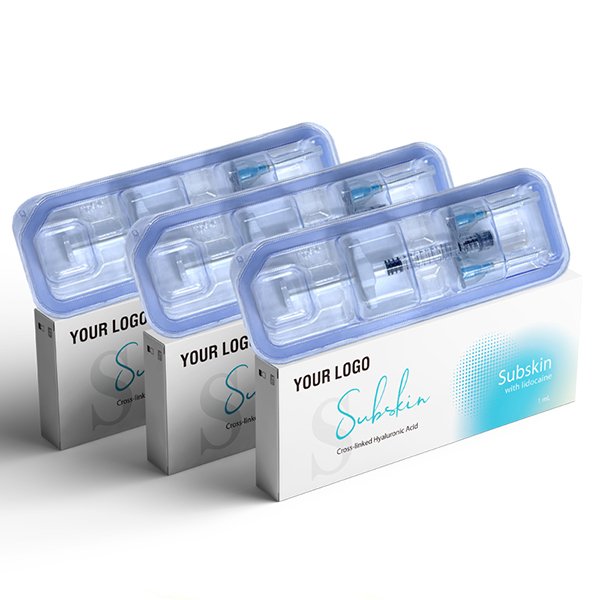
A: Control exists on a spectrum. At a baseline, you fully control: brand name, logo, outer packaging, carton design, and Instructions for Use. The next level involves syringe type (luer lock vs. luer slip), needle gauge, and volume marking. Advanced, collaborative partnerships allow for customization of the gel itself: hyaluronic acid concentration (e.g., from 20mg/mL to 28mg/mL), cross-linking ratio (affecting durability and G-prime), particle size (for fine lines vs. volume), and the inclusion of pre-mixed lidocaine. This deeper level requires shared R&D investment and regulatory re-certification.